
Quartz vs Granite vs Marble Countertops in Denver
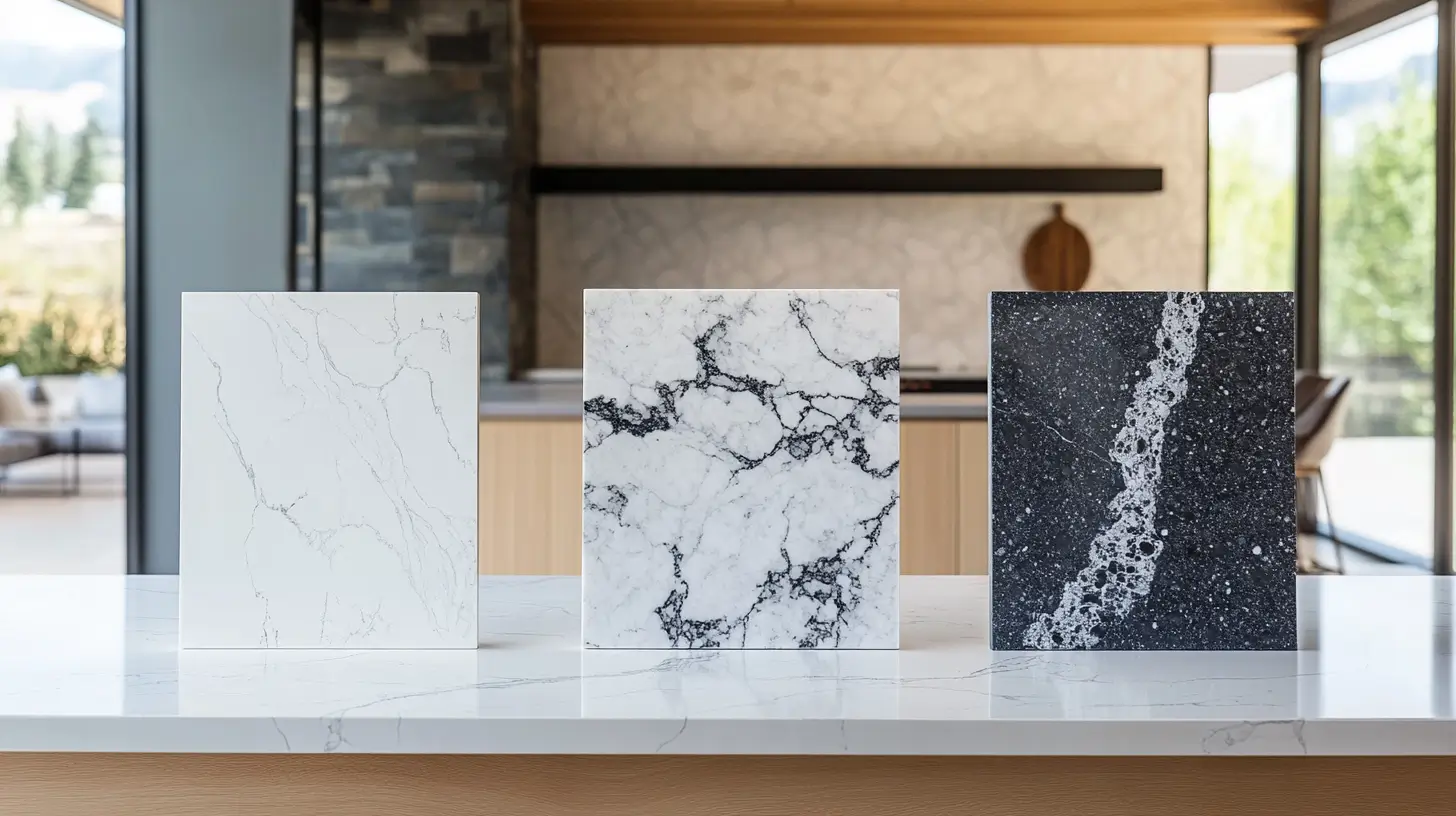
Countertops are the most-touched surface in any kitchen. They take heat from pans, water from the sink, knife marks, spilled wine, and a decade or two of daily use before anyone thinks about replacing them. Picking between quartz, granite, and marble usually happens fast during a remodel, often based on a showroom slab and a sales pitch, with the actual living-with-it questions left for later. Three months in, homeowners learn what their countertop will and will not tolerate, and by then the decision is permanent.
This article compares the three most common stone-category countertops on the Denver market: engineered quartz, natural granite, and natural marble. It covers what each one is actually made of, how they perform in real kitchens, what they cost installed, and the choices that matter most before signing a slab agreement. By the end you should know which material fits how you actually cook.
The key decisions at a glance
Quartz: Engineered, non-porous, low maintenance, broad style range, no sealing required.
Granite: Natural stone, very durable, heat tolerant, requires periodic sealing, every slab is unique.
Marble: Natural stone, softer and more porous, etches under acids, develops a patina, premium look.
Cost spread: All three overlap, with granite often the cheapest and marble the most expensive at comparable thickness.
Lifestyle fit: The right choice depends more on how you cook than on what looks best in the showroom.
Quartz: engineered for daily use
Quartz countertops are not pure quartz. They are roughly 90 to 95 percent ground natural quartz bound together with resin and pigment, manufactured into uniform slabs by companies like Caesarstone, Cambria, Silestone, and MSI. The result is a non-porous surface that resists stains, never needs sealing, and comes in a much wider range of consistent colors and patterns than natural stone, including marble-look quartz that mimics the veining of Calacatta or Carrara at a fraction of the maintenance.
Installed costs in Denver run roughly $60 to $120 per square foot in 2026, putting a typical 50 square foot kitchen countertop project at $3,000 to $6,000. Higher-end designer collections push beyond that. The quartz price is usually closer to mid-grade granite than premium granite, which is one reason it has become the default choice in many Denver remodels.
The trade-off is heat sensitivity. Quartz resin can discolor or warp when exposed to direct heat above about 300 degrees, which means hot pans need a trivet or hot pad. Most homeowners adjust quickly, but if you routinely set pans directly on the counter, this is worth knowing before committing. Quartz also will not look like real stone up close. The patterns are convincing from across the room, less so under direct lighting.
Where quartz makes sense: families with kids, homeowners who want low maintenance, light-colored kitchens (white quartz hides scratches better than dark), and any kitchen where consistency across slabs matters for a clean modern look.
Granite: natural, durable, every slab unique
Granite is a true natural stone, quarried in large blocks and cut into slabs. Every slab is one-of-a-kind, with patterns, veining, and color variation that quartz cannot replicate. It is harder than marble, tolerates heat well (you can set a hot pan directly on it without damage), and resists scratches better than most other countertop materials. Properly sealed, it shrugs off most stains.
Installed costs in Denver run roughly $50 to $110 per square foot for most colors, with rare and imported granites pushing higher. A 50 square foot kitchen runs $2,500 to $5,500, often the lowest cost of the three materials at comparable thickness, though designer granites can cost as much as marble.
The maintenance is the most overlooked part of granite ownership. The stone is porous, which means it needs sealing when first installed and re-sealing every one to three years depending on the color and use. A bead of water that soaks into the granite within a few minutes means it is time to reseal. The actual sealing process takes about 30 minutes and a $30 bottle of sealer, but skipping it for years can let stains set permanently.
Where granite makes sense: cooks who use a lot of heat, homeowners who want a unique surface, traditional and transitional kitchen styles, and budgets that benefit from granite's cost advantage over quartz in many color ranges.
Marble: premium, soft, alive
Marble is the most beautiful and the most demanding of the three materials. Carrara, Calacatta, and Statuario marbles have a depth and veining that no engineered material can fully replicate, and a polished marble surface has a luminance under kitchen lighting that other stones do not match. The trade-off is durability. Marble is softer than granite, etches under contact with acids (lemon juice, vinegar, tomato sauce, wine, citrus), and stains more easily than either alternative.
Installed costs in Denver run roughly $75 to $200 per square foot, with premium Italian marbles pushing well above that. A 50 square foot kitchen runs $3,750 to $10,000 or more. The price overlaps with high-end quartz and granite at the lower end and exceeds them at the higher end.
The conversation about marble in a working kitchen usually comes down to one question: how much do you mind a patina? Etching is unavoidable on polished marble used as a kitchen countertop, and within a year or two the surface develops a softer, matte look in high-use areas around the sink and prep zones. Some homeowners love this; others are miserable. Honed (matte-finish) marble shows etching less than polished marble, which is one reason many marble kitchens use a honed finish despite losing some of the visual brilliance.
Where marble makes sense: homeowners who appreciate patina, kitchens where the aesthetic matters more than perfect durability, baking-focused kitchens (marble's cool surface is ideal for pastry work), and homes where the design language genuinely calls for it.
What matters more than the material
Three secondary decisions affect how happy you are with whatever you pick: edge profile, slab selection, and fabrication quality. A square eased edge looks more modern than a bullnose; ogee and waterfall edges read traditional or contemporary respectively. Each profile changes the visual weight of the countertop and the cost. Edge details add roughly $5 to $25 per linear foot depending on complexity.
Slab selection matters most for natural stone. With granite and marble, you should physically pick the slab at the supplier's yard, not approve a small sample. Slabs vary substantially even within a named color, and a slab that photographs well can read very differently under your kitchen lighting. The supplier will hold the slab for you for a small reservation fee while your fabricator measures.
Fabrication is the difference between a beautiful kitchen and a disappointing one. The seam placement, the cutout alignment around the sink and cooktop, the edge finishing, the overhang dimension, and the support brackets all come down to the fabricator's skill. A cheap fabricator working with an expensive slab can ruin the project. Ask to see the fabricator's previous installations and read reviews specifically about seam quality and template accuracy.
Common mistakes homeowners make
The first mistake is picking the material from a small sample without considering the full slab. Color, veining, and pattern read very differently in a 2-inch sample than in a 9-foot slab. For natural stone, always visit the supplier's yard before signing.
The second mistake is underestimating maintenance commitment. Marble requires daily care to look its best. Granite needs periodic sealing. Quartz is the only one of the three that genuinely requires no maintenance. If you are not someone who will keep up with care routines, the material choice should reflect that.
The third mistake is paying premium for an exotic stone and pairing it with a budget fabricator. The fabrication quality compounds the material choice in both directions. A mid-grade granite installed by a great fabricator looks better than premium marble installed badly.
The fourth mistake is ignoring how the countertop interacts with the cabinets. Cabinet decisions made first can constrain countertop choices later, particularly with overhang depth, edge profile compatibility, and seam placement.
What this means for your decision
The right material depends on three things you already know about yourself: how you cook, how much maintenance you will actually do, and how much the look matters relative to durability. Walk through those answers honestly before getting attached to a specific slab.
If you are planning a broader remodel, the countertop decision belongs in the same conversation as cabinet style, backsplash, and lighting. Kitchen layout decisions often constrain countertop options more than homeowners expect, particularly around island sizing and seam locations.
If you are still scoping the project, current Denver kitchen remodel pricing shows where countertops fit in the overall budget. The decisions that last covers which choices in a kitchen remodel actually matter five and ten years out.
Working with a Denver fabricator
The countertop fabricator is often a separate vendor from the general contractor on a kitchen remodel, but the two need to coordinate closely. A good fabricator will visit the job site to template after the cabinets are installed, walk you through slab selection at the supplier, explain seam placement options honestly, and stand behind the work if something measures wrong. DDB's kitchen service overview covers how we coordinate fabrication, cabinets, and finish work on a kitchen project.