
Kitchen Cabinet Decisions: Custom vs Stock, Framed vs Frameless, and What Actually Matters Long-Term
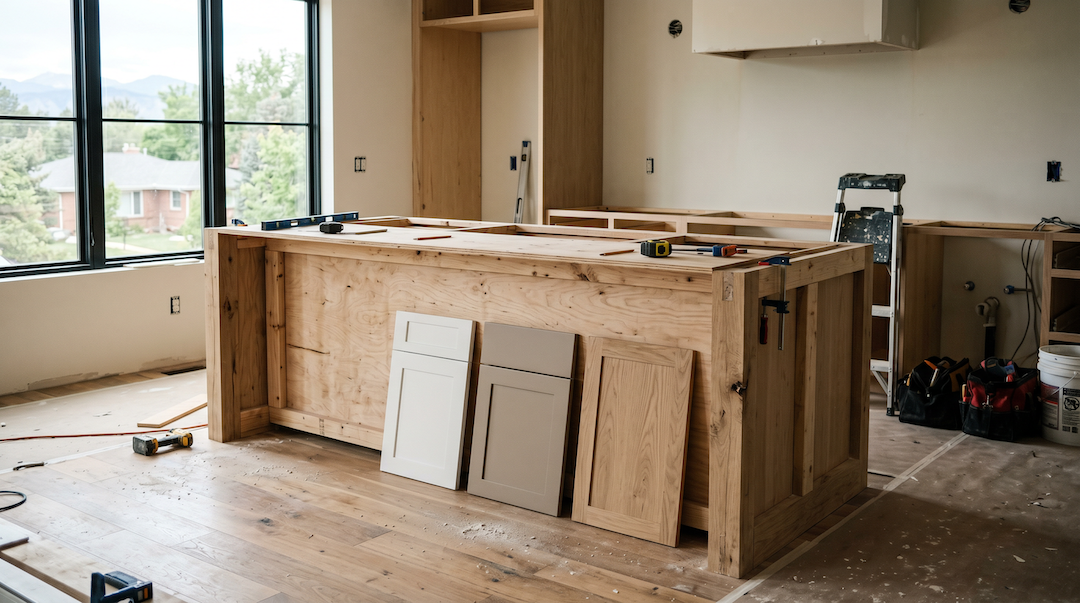
How to Choose Kitchen Cabinets in Denver
Cabinets are the single biggest visual element in any kitchen, and they're usually the largest line item in a remodel budget. Most homeowners walk into the design process knowing they want "white cabinets" or "shaker style" and discover quickly that those broad preferences barely scratch the surface of the actual decisions ahead.
The cabinet decisions homeowners make at the start of a kitchen remodel determine more than how the kitchen looks. They drive the budget, the timeline, the durability, and how the kitchen will hold up ten years from now. Understanding the major decision points before you sit down with a designer or contractor will help you control your budget, avoid delays, and end up with a kitchen that still works ten years from now.
The key decisions at a glance
- Cabinet type: stock, semi-custom, or custom
- Construction: framed vs. frameless
- Door style and overlay
- Finish: paint, stain, or natural wood
- Hardware, drawer construction, and interior storage
- How cabinet decisions affect the rest of the project
What cabinets actually cost in a Denver remodel
Cabinets typically account for 25 to 40 percent of a full kitchen remodel budget. That share goes up for high-end custom work and down for stock or modest semi-custom installs, but the range holds for most Denver projects. Understanding that going in helps homeowners make sense of the decisions below, because the cabinet choices are not just about how the kitchen looks, they are about which line item gets the largest slice of the budget.
Custom, semi-custom, or stock cabinets
This is the first decision and it shapes everything downstream. The three categories aren't just price tiers, they're fundamentally different products built on different timelines.
Stock cabinets are mass-produced in standard sizes, typically in 3-inch increments. They come pre-assembled or flat-packed, ship within days or a couple of weeks, and represent the lowest cost option. The tradeoff is fit. If your kitchen has any irregularity, and most older Denver homes do, you'll have filler strips and gaps that compromise the finished look. Stock works well for new construction with predictable wall measurements or for budget-conscious remodels where the layout happens to align with standard sizes.
Semi-custom cabinets start with a stock catalog but allow modifications, such as depth changes, height adjustments, custom finishes, and selected door style options. Lead times typically run six to ten weeks. The cost premium over stock is significant but not extreme, and the fit-to-space improvement is substantial. For most remodels in existing Denver homes, semi-custom is the practical sweet spot.
Custom cabinets are built specifically for your kitchen by a local cabinet maker or a higher-end manufacturer. Every dimension can be specified, every finish matched, every storage solution tailored. Lead times often run twelve to twenty weeks. The cost is materially higher, sometimes two to three times semi-custom pricing, but the result is a kitchen with no compromises and no filler strips. Custom makes sense for high-end remodels, unusual layouts, or homeowners who want specific storage configurations that catalogs don't offer.
The decision often comes down to budget and timeline. If you're trying to break ground in spring and you start cabinet shopping in February, custom is probably off the table. If your budget is tight, the cost difference between stock and semi-custom may be more than the layout requires.
Framed versus frameless construction
This is one of the decisions homeowners often don't realize they're making until a designer asks. The framed-versus-frameless distinction affects the look, the storage capacity, and the price.
Framed cabinets, sometimes called American-style, have a face frame attached to the front of the cabinet box. The doors and drawers attach to this frame. This is the traditional construction method, and it's what most American kitchens have used historically. The face frame adds rigidity and gives certain door styles, particularly inset doors, a place to sit. They tend to read as warmer and more traditional.
Frameless cabinets, sometimes called European-style or full-access, skip the face frame entirely. The doors mount directly to the side of the cabinet box. This means more usable interior space, typically 10-15 percent more storage in the same footprint, because there's no frame eating into the opening. They tend to read as cleaner and more modern, with less wood showing on the cabinet face.
Frameless used to carry a price premium because the construction tolerances are tighter, but the gap has narrowed considerably. For modern kitchens with full-overlay or slab doors, frameless is usually the better choice. For traditional kitchens with inset doors and visible face details, framed construction is often the right fit. Neither is universally better. They're suited to different design directions.
Door style and overlay
Door style is the most visible cabinet decision and the one homeowners spend the most time on. The choices have settled in recent years around a handful of categories.
Shaker doors, characterized by a flat center panel surrounded by a simple frame, remain the most popular style nationally and in Denver specifically. They suit modern, traditional, transitional, and farmhouse kitchens equally well, which is part of why they're recommended so often. The risk is the same risk all popular choices carry, which is dating your kitchen to the era when the style peaked.
Slab doors, which are flat panels with no detail, are the modern choice. They work in contemporary kitchens, minimalist designs, and any space where the cabinetry should disappear visually. Slab doors in matte finishes, particularly muted colors like clay, sage, or warm gray, are showing up more often in higher-end Denver remodels.
Inset doors, where the door sits flush within the frame rather than overlaying it, are a custom or high-end semi-custom feature. They require tighter tolerances and more skilled installation. They give a kitchen a built-in furniture quality that overlay doors can't match. They're typically more expensive and have less forgiving fit if your house settles.
Beyond door style, you'll choose an overlay type. Full overlay means the door covers most of the cabinet face, with thin reveals between doors. Partial overlay leaves more frame visible. Inset, as noted, sits flush. The visual difference is substantial. Full overlay reads as more contemporary and seamless, partial overlay reads as more traditional, inset reads as custom and crafted.
Paint, stain, or natural finish
The finish decision is part aesthetic, part practical. Each option has tradeoffs that show up over time.
Painted cabinets, almost always in white or a soft neutral, give you the cleanest look and the broadest design flexibility. They show wear differently than stained wood. Chips, scuffs, and yellowing happen, particularly near high-use areas like the trash pull and the cabinets next to the stove. High-quality factory finishes resist these issues better than on-site painting, but no painted cabinet is invulnerable. Touch-up kits exist and are part of life with painted cabinets.
Stained wood cabinets show grain and warmth that paint can't replicate. They hide minor wear better than paint because scratches and dings reveal more wood underneath rather than a different color. The tradeoff is design flexibility. Once you commit to a stain, you've committed to a look that's harder to update later. Repainting stained cabinets is possible but rarely produces the same quality as factory-finished paint.
Natural or lightly finished wood, particularly white oak, walnut, and rift-cut oak, has had a strong return in higher-end kitchens. The look is warm, modern, and architectural. The tradeoff is cost, since the wood species themselves are more expensive, and color consistency, since natural variation is part of the look but can read as inconsistency to homeowners expecting uniformity.
For Denver kitchens specifically, painted cabinets in warm whites and soft neutrals continue to dominate. Natural wood is showing up more often in higher-budget remodels, particularly when paired with darker base cabinets and lighter uppers. The two-tone approach is one of the patterns showing up across popular kitchen design styles homeowners are using in Denver over the last few years.
Hardware and the small decisions that compound
Hardware, hinges, drawer slides, and interior accessories are easy to overlook during the early planning stages but they affect daily use of the kitchen for as long as you own the home.
Soft-close hinges and drawer slides are now standard in most semi-custom and custom cabinetry. Confirm this rather than assume it. Cheap hinges fail within a few years. Replacing them isn't expensive, but it's a headache you'll wish you avoided.
Drawer construction quality matters. Dovetail joinery on solid wood drawers will outlast stapled particleboard by decades. The cost difference at purchase is small. The cost difference at year fifteen is enormous because the cheap drawers have failed and the dovetailed ones are still functioning.
Interior organizers, including pull-out trash and recycling, drawer dividers, vertical tray storage, and pull-out pantry shelves, are easier to spec at build time than to retrofit later. List how you actually use your current kitchen, what frustrates you about storage, and what you wish you had. Bring that list to your designer rather than choosing organizers from a catalog without context.
Cabinet pulls and knobs are the cheapest way to update the look later, so don't agonize over them at build time. Get something neutral that works, and replace them in five years if you want a new look.
How cabinet decisions affect the rest of the project
Cabinets drive a surprising amount of the rest of the kitchen design. The cabinet style limits or expands countertop options. The cabinet color affects flooring choices. The cabinet construction determines what hardware will physically work. Most importantly, the cabinet lead time often determines the construction schedule, because demolition and rough-in work has to be sequenced around when the cabinets actually arrive.
Decisions made early in the process, particularly cabinet decisions, are the ones homeowners live with longest after the kitchen is finished. Spending real time on these decisions, asking specific questions, looking at samples in your actual kitchen lighting, and getting clarity on lead times before you commit, is one of the highest-leverage uses of the design phase.
For most remodels, the cabinet conversation should happen with your contractor and designer together, before walls are opened, before plumbing is moved, and before any other decisions get locked in. The cabinets are the anchor. Everything else gets coordinated around them.
If you're planning a kitchen remodel and trying to make sense of these decisions, working with an experienced Denver kitchen remodel contractor who has done this work before will keep the project moving and prevent expensive resets later. The right contractor doesn't just build the kitchen, they walk the homeowner through the cabinet decisions in the right order, with the right tradeoffs, before anything gets ordered.