
Sewer Line Replacement in Denver
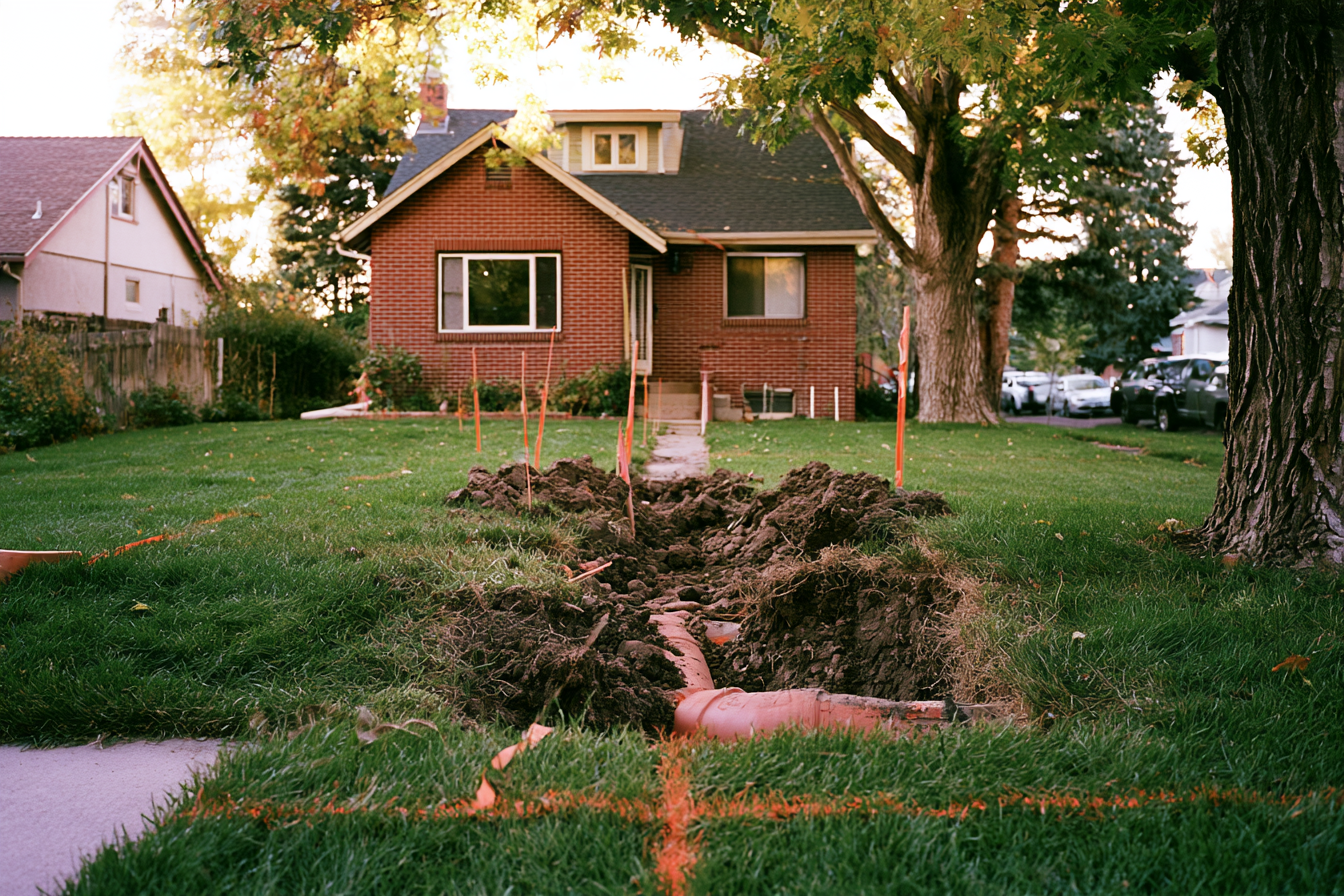
Most Denver homeowners never think about their sewer line until something forces them to. It is buried, it is out of sight, and in a lot of Denver neighborhoods it is also 80 to 100 years old. If you own a home in Park Hill, Wash Park, Berkeley, or any of the city's older blocks, there is a decent chance your house still drains through the original clay pipe. This article covers how to find out what you have, what repair and replacement actually cost, and how to avoid paying for a full dig when a smaller fix would do.
Why Denver's housing stock makes this a local problem
A huge share of Denver homes were built between 1900 and 1960, and most of those were plumbed with vitrified clay sewer pipe. Clay does not rust, but it is brittle, it is jointed every few feet, and every joint is an invitation for tree roots. Denver's mature street trees, the same ones that make these neighborhoods worth living in, spend every summer pushing roots toward the nearest source of water. That is usually your sewer lateral.
The other common failure is settling. Denver's expansive clay soils move with moisture cycles, and a pipe that has been in the ground since the Coolidge administration has had a century of freeze-thaw and soil movement working on it. Sections sink, joints offset, and you end up with a low spot, called a belly, where waste sits instead of flowing.
None of this means every old line is failing. Plenty of clay laterals still work fine. It means you should know what you have before you remodel, before you buy, and before you finish a basement that a backup would ruin.
Start with a sewer scope, not a guess
A sewer scope is a camera inspection of your lateral from the house to the city main. In Denver it runs $150 to $400, and it is the single best money you can spend on this problem. The scope tells you the pipe material, where the roots are, whether joints have offset, and whether you have a belly, and a good operator will locate problem spots from the surface so you know exactly where the trouble sits in your yard.
If you are buying an older Denver home, scope the sewer before closing. It is not part of a standard inspection, and a failed lateral is a five-figure surprise. If you are planning a larger renovation of an older property, the same logic applies, and it is one of the first things worth checking before you commit a budget. Our guide to historic home renovation in Denver covers the rest of what these houses tend to hide.
Repair, line, or replace: the three paths
Spot repair. If the scope shows one bad section, a crushed spot under the yard or a single offset joint, a crew can excavate just that section and replace it. In Denver this typically runs $3,000 to $8,000 depending on depth and access. Depth matters more than distance. A lateral six feet down is a different job than one eleven feet down.
Trenchless lining. If the pipe is structurally intact but root-invaded or leaking at the joints, cured-in-place pipe lining threads a resin sleeve through the existing line and hardens it into a new jointless pipe inside the old one. Lining typically costs $80 to $250 per linear foot in the Denver market, and most residential laterals come out between $6,000 and $15,000. The appeal is obvious: no trench through your landscaping, your sidewalk, or your new driveway. The catch is that lining needs a mostly round, mostly aligned host pipe. A collapsed section or a bad belly cannot be lined.
Full replacement. When the line has multiple failures, a full dig-and-replace runs $8,000 to $20,000 for most Denver homes, and more when the line runs deep, crosses a street, or requires city right-of-way work. Replacement resets the clock entirely. New PVC laterals are jointless for practical purposes and root-resistant in a way clay never was.
A contractor who scopes your line and goes straight to the most expensive option without walking you through the footage is telling you something. Ask to see the video. Any honest operator will show you exactly what the camera saw.
Permits and the city's role
Sewer work in Denver requires a permit, and work in the public right-of-way, which is anything between your property line and the main, involves additional licensing and inspection. This is not a corner to cut. An unpermitted sewer repair can surface during a sale and cost you the deal. If you want to understand how the city's process works more broadly, including what triggers a permit and how long approvals take, we cover it in our guide to Denver home remodel permits.
One more Denver-specific note: if your plans include a basement ADU or any project that adds significant fixtures, the city will care about the capacity and condition of your lateral. Older lines that are marginal for a single household can be flagged when you add a second unit. If that is your direction, our breakdown of basement ADUs in Denver explains where sewer capacity fits in the approval process.
What a failing line does to the rest of your house
Sewer problems rarely stay sewer problems. A slow backup pushes moisture into the basement, and moisture is the enemy of everything you might want to do with that space. If your long-term plan involves finishing the basement, get the sewer sorted first, the same way you would address water intrusion before hanging drywall. Our article on handling basement moisture before you finish walks through that sequencing.
The common mistakes here are all versions of the same one: reacting instead of planning. Homeowners snake the line every spring for years, spending $300 a visit to buy time on a pipe that needed lining five years ago. Or they finish a basement over a known-marginal lateral. Or they replace a driveway a year before a full sewer dig goes through it. The scope footage tells you which path you are on. Use it to sequence the work, not just to survive the current backup.
Where a general contractor fits
A standalone sewer repair is plumber's work. But sewer lines have a way of surfacing in the middle of bigger projects: the remodel that triggers a scope, the ADU that needs capacity, the basement that needs the line fixed before finishing starts. That is coordination work, sequencing excavation, permits, inspection, and the trades that follow. It is what our general contracting service exists to handle.
If your house is on one of Denver's older blocks and you have never seen your lateral on camera, spend the $300. It is the cheapest insurance in residential construction, and it turns the biggest unknown under your yard into a line item you can plan around.