
Engineered vs Solid Hardwood Floors in Colorado
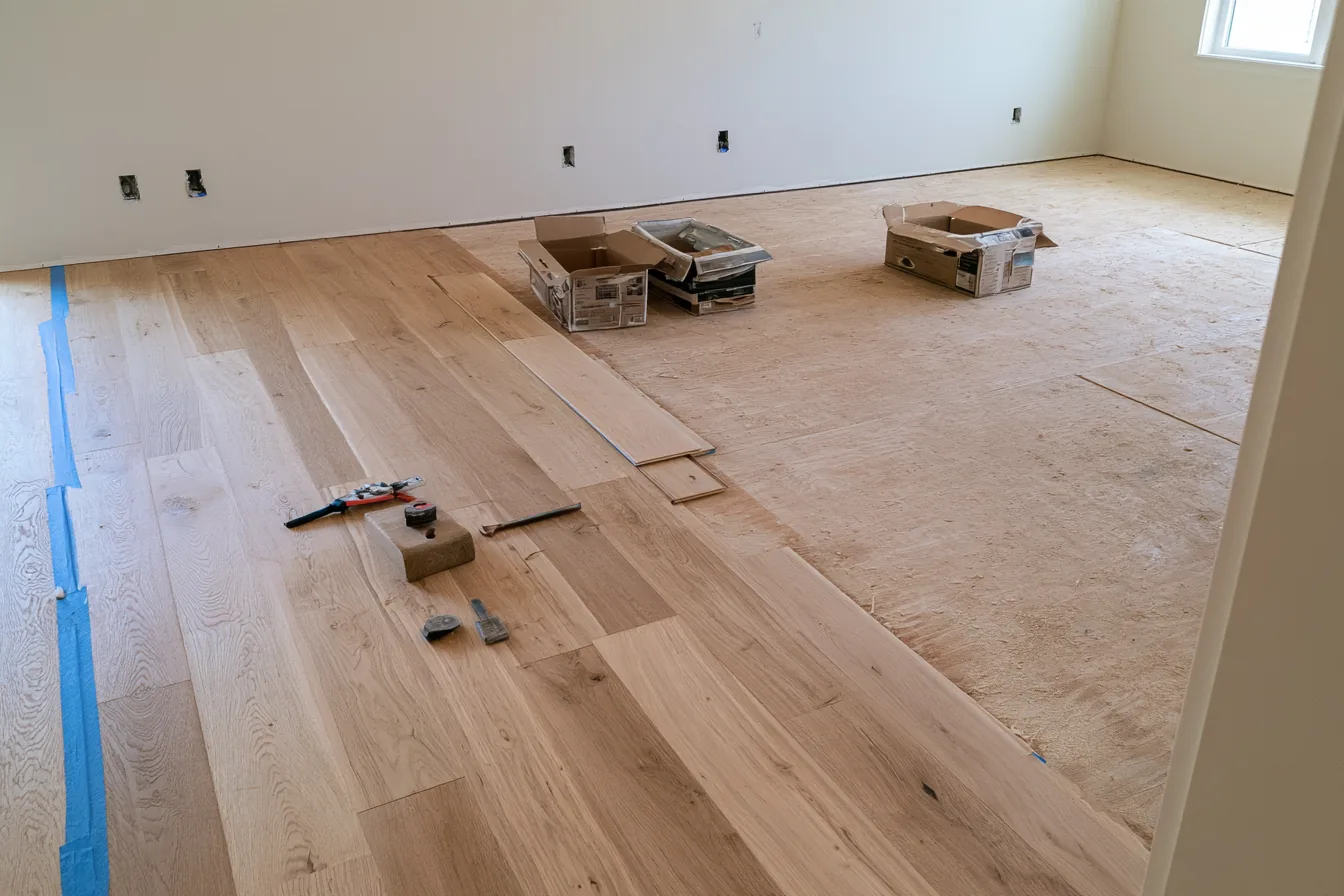
Engineered and solid hardwood look the same once they are on the floor. Both have a real hardwood surface, both can be stained and finished the same way, and most buyers walking through a house cannot tell them apart. The difference is underneath, in how each board is built, and that difference matters more in Colorado than almost anywhere else because of how dry the air gets here and how much it swings between seasons.
This article explains how the two products are made, how each one behaves in Front Range humidity, where each can and cannot go, how many times each can be refinished, and what each costs installed. By the end you should know which one fits each floor of your house and what has to happen during installation for either to perform.
How each board is built
Solid hardwood is exactly what it sounds like: a single piece of wood, usually three quarters of an inch thick, milled with a tongue and groove and nailed to a wood subfloor. Every board is one species from top to bottom.
Engineered hardwood has a top layer of real hardwood, called the wear layer, bonded to a core of cross-laminated plywood or a dense fiberboard. The core layers run in alternating directions, so each layer resists the movement of the one next to it. A common question is whether engineered hardwood is real wood. It is. The surface you walk on is a slice of oak, maple or walnut, and it is sanded, stained and finished like any hardwood. It is not laminate, which uses a printed photograph of wood under a plastic wear coat, and it is not vinyl.
That cross-ply core is the whole point. Wood moves mostly across its width as it gains and loses moisture. A solid board is free to shrink and swell across its full width. In an engineered board the core layers fight that movement, so the plank stays much closer to its installed size as the seasons change.
Why Colorado air changes the answer
The National Wood Flooring Association recommends keeping wood floors in a home between 30 and 50 percent relative humidity. Denver spends a lot of the year below that. Winter indoor humidity in a heated Front Range house routinely drops under 20 percent, and summer storms and swamp coolers can push it back toward 50 or 60. Wood follows the air. When the humidity falls, boards give up moisture and shrink. When it rises, they take moisture back and swell.
For solid hardwood that cycle shows up as winter gapping. The boards shrink and open visible cracks between them, often wide enough to catch a fingernail, and then close again in summer. A small amount of seasonal gapping is normal for solid wood and is not a defect. In a Colorado house without humidity control, though, it can be dramatic, and wide-plank solid floors gap more than narrow ones because each board has more width to lose.
Cupping is the opposite problem. A cupped board has edges higher than its center, which happens when the bottom of the board is wetter than the top. In Colorado that usually traces to moisture from below, such as a damp crawlspace, a slab that was never tested, or a leak, rather than humid air. Cupping is a warning sign that something under the floor needs attention.
Engineered flooring is not immune to any of this, but it moves far less. That is the main reason it has become the default wood floor in new Denver construction and most remodels. If you want solid hardwood here, plan on a whole-house humidifier to hold the home in that 30 to 50 percent range through the winter. Installed humidifiers commonly run $600 to $2,500, and that cost belongs in the solid hardwood budget from the start.
Acclimation is about moisture, not days
Every wood floor needs to reach a moisture content that matches the house it is going into before it is installed. In Denver that typically takes anywhere from 72 hours to two weeks, depending on the product, the species and the season. Flooring shipped from a humid warehouse or a different region can arrive well above the moisture level it will settle at here.
The right way to handle acclimation is with a moisture meter, not a calendar. The installer measures the subfloor and the flooring, compares the two, and installs when they are within the manufacturer's allowed range. A crew that drops boxes in your garage on Monday and installs on Tuesday is skipping the step that prevents most gapping and buckling complaints. Some engineered products need little or no acclimation under the manufacturer's instructions, which helps on a tight schedule. When you are vetting installers, our guide on what to ask a Denver flooring contractor before hiring includes the acclimation question.
Basements, slabs and radiant heat
Location in the house rules out solid hardwood in more places than people expect. Solid wood should not go below grade, meaning a floor with soil against the walls above the floor level. Most Denver basements fall in that category. Engineered flooring is the recommended wood option below grade, either glued directly to the slab or floated over a moisture barrier, and only after the concrete has been tested and found dry enough. If the slab tests wet, the answer is not wood of any kind until the moisture problem is solved.
On-grade slabs, such as a ranch or a garage conversion built on concrete, can take solid hardwood, but only with a plywood subfloor installed over a vapor retarder to give the nails something to hold. That adds height and cost. Engineered flooring can be glued straight to the slab, which is simpler, thinner and usually cheaper.
Radiant floor heat is the other case where engineered wins clearly. Heated floors dry the wood directly from below, which is a harder version of the Denver winter problem. NWFA guidance limits wood floor surface temperature to around 80 degrees Fahrenheit, and less stable species such as maple, hickory and birch are generally not recommended over radiant systems. Engineered oak or walnut with a stable plywood core is the usual choice, and the flooring manufacturer has to approve it for radiant use or the warranty will not hold.
Refinishing and wear layer thickness
The main thing solid hardwood offers over engineered is how many times it can be sanded. A three quarter inch solid board has roughly a quarter inch of wood above the tongue, and a careful sanding removes only a small fraction of that. A solid floor can be refinished many times over a lifespan measured in generations. That is why 90 year old floors in Denver bungalows can still be restored.
Engineered flooring can only be sanded through its wear layer, so the thickness of that layer decides the floor's long-term value. Industry guidance breaks down roughly like this. A 1 millimeter wear layer cannot be sanded at all and can only be screened and recoated. A 2 millimeter layer allows one or two full sandings. A 3 millimeter layer allows two or three. A 4 millimeter layer allows three or four, which puts it close to solid wood in practical terms. The cheapest engineered products on the market use very thin wear layers, and that is often the reason they are cheap.
For most homeowners, a 3 millimeter or thicker wear layer is the right target. A full refinish is typically needed every 10 to 15 years in a lived-in house, so a 3 or 4 millimeter engineered floor can realistically last as long as you are likely to own the home. A 1 millimeter floor is closer to a disposable product with a real wood face.
What each costs installed
In the Denver market, engineered hardwood typically runs $8 to $16 per square foot installed, with mid-grade products around $8 to $12 and wide-plank white oak toward the top of the range. Solid hardwood typically runs $10 to $22 per square foot installed, depending on species, plank width, grade and whether it is prefinished or sanded and finished on site. Those are the same ranges in our room-by-room flooring installation cost guide for Denver, and national guides put the two at about $9 to $20 and $11 to $25 respectively.
On a 1,000 square foot main floor, that works out to roughly $8,000 to $16,000 for engineered and $10,000 to $22,000 for solid, before subfloor repairs, stairs or trim. Solid hardwood can also bring added costs that do not show up in the per square foot price: a plywood subfloor on a slab, the humidifier mentioned above, and the longer schedule of a site-finished floor, which can add a week or more of drying time before you can move furniture back.
The gap is smaller than many people expect at the same quality level. A thick-wear-layer engineered white oak and a solid white oak of the same width and grade often land within a few dollars per square foot of each other. The real price difference shows up at the bottom of the engineered market, where thin wear layers and fiberboard cores bring the cost down.
Choosing for your house
For most Colorado homes, engineered hardwood with a 3 millimeter or thicker wear layer and a plywood core is the more practical choice. It handles the dry winters with less gapping, it can go below grade and over slabs and radiant heat, it installs faster, and it can still be refinished several times.
Solid hardwood still makes sense in specific situations: matching or extending an existing solid floor in an older home, owners who plan to keep the house for decades and want the maximum number of refinishes, and homes that already run a whole-house humidifier. In those cases solid wood is a good floor that just asks for more care.
If you are still deciding whether to use wood at all, our article on hardwood versus LVP flooring for Denver homes covers that choice. Once you have settled on wood, the product decision is only half of it. Moisture testing, subfloor prep and acclimation decide whether either floor performs. Our flooring installation team in Denver tests the subfloor, meters the wood before it goes down, and will tell you plainly which product suits each level of your house.