
Concrete Patio vs Pavers in Denver
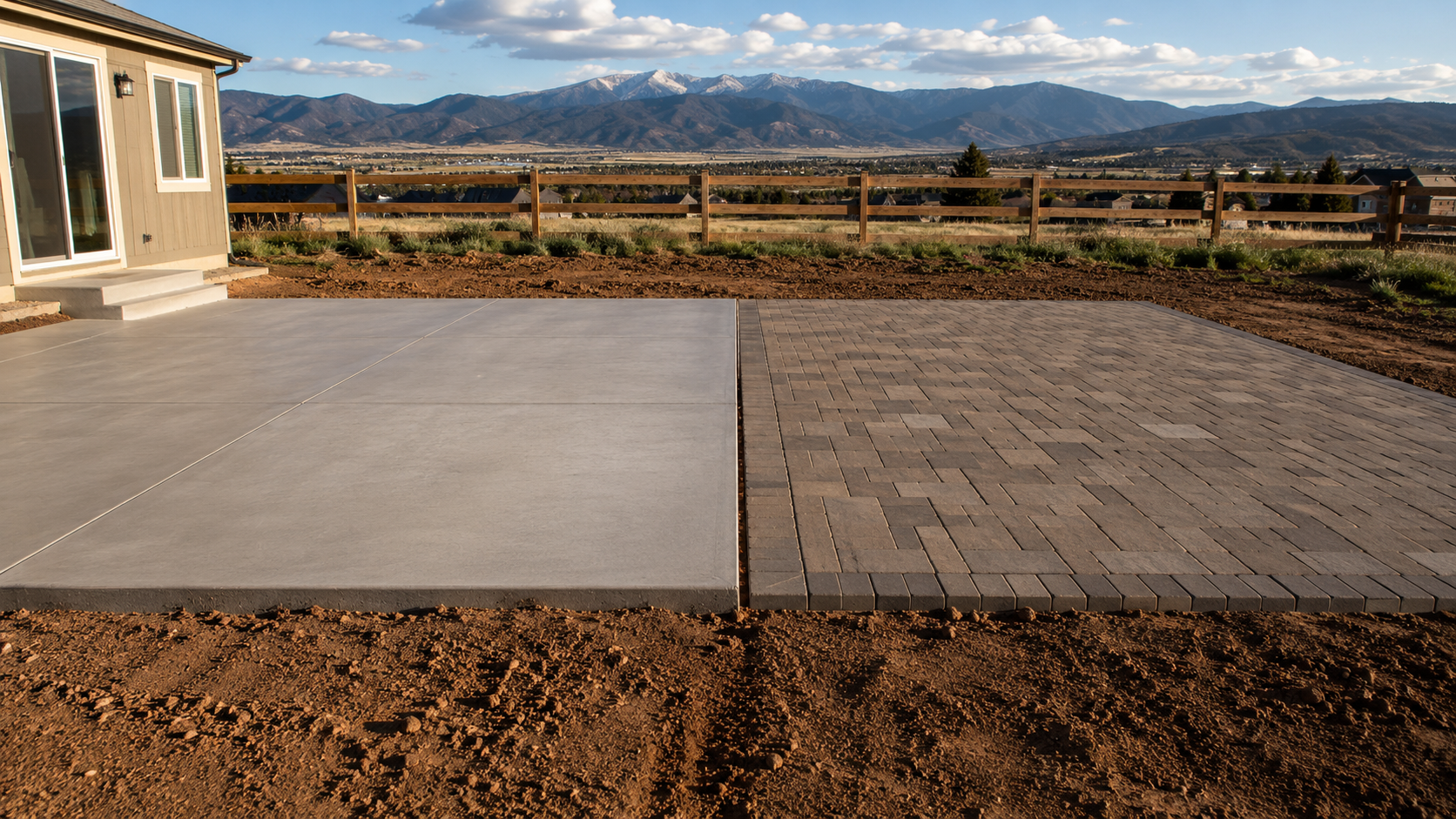
When a Denver homeowner starts planning an outdoor patio, the decision usually comes down to three options: poured concrete, pavers, or stamped concrete. Each has a different cost profile, a different look, and a different relationship with Denver's freeze-thaw cycle and expansive clay soils. Picking the right one depends less on what looks best in a photo and more on how the patio will be used, how much maintenance the homeowner is willing to do, and how the surface will hold up after a decade of Colorado weather. This article breaks down what each option actually costs, where each performs best, and the tradeoffs that Denver homeowners tend to underestimate.
The key decisions at a glance
What poured concrete costs and delivers
A standard poured concrete patio in Denver runs between $8 and $15 per square foot installed, making it the cheapest of the three options. For a typical 300-square-foot patio, that lands between $2,400 and $4,500 all-in. The finish is clean, the installation is fast, and the result is a flat, functional surface that works well for furniture, grills, and general outdoor use.
The tradeoff is design range. Poured concrete comes in one basic finish unless the homeowner adds staining, scoring, or an exposed aggregate treatment, each of which adds cost. Concrete is also rigid, which matters in Denver. A monolithic slab poured over expansive clay soil is more likely to crack than a flexible system, and once it cracks, the repair options are limited. Patching is visible, and a significant crack in a large slab often means replacing a full section rather than fixing the break.
What pavers cost and deliver
Interlocking concrete pavers or natural stone pavers run between $15 and $30 per square foot installed in Denver, depending on material and pattern complexity. That same 300-square-foot patio lands between $4,500 and $9,000. The higher cost buys two things: design flexibility and repairability.
Pavers come in dozens of shapes, colors, and patterns. They can match nearly any home style and age well when properly installed. More importantly for Denver, pavers are individual units set on a compacted base with sand joints. When the ground shifts, individual pavers can move slightly without cracking. If one unit does crack or stain badly, it can be pulled and replaced without disturbing the rest of the surface. In a market where expansive soils cause consistent ground movement, that modularity is a meaningful advantage over any monolithic surface.
The downside is that pavers require periodic maintenance. Joints need re-sanding every few years, weeds can grow between units, and settling requires occasional releveling. None of these are expensive, but they are recurring.
Stamped concrete as the middle option
Stamped concrete falls between the other two on cost, typically $12 to $20 per square foot installed. It offers the design appeal of pavers on a poured-concrete base. For homeowners who want more visual interest than plain concrete but do not want the maintenance of pavers, stamped concrete looks like the obvious compromise.
The problem is durability in Denver's climate. Stamped concrete develops hairline cracks just like regular concrete, but because the surface has a stamped texture and often a colored sealant, those cracks are more visible and harder to repair seamlessly. Resealing is required every two to three years to maintain the color and protect against freeze-thaw damage, and if the sealant fails, moisture gets into the surface and accelerates deterioration. In Denver's UV-heavy, freeze-thaw-heavy environment, stamped concrete ages faster than either alternative unless the homeowner stays on top of sealing.
How Denver's climate and soil change the math
Two factors make Denver different from most patio markets. The first is the freeze-thaw cycle. Denver regularly sees overnight lows below freezing from October through April, often followed by daytime highs above 50 degrees. Water that penetrates any concrete surface freezes, expands, and breaks the material from within. This cycle repeats hundreds of times per year, and it is harder on rigid monolithic surfaces than on flexible modular ones.
The second factor is expansive clay soil, which is common across the Denver metro. Clay soils swell when wet and shrink when dry, creating ground movement that shifts foundations, slabs, and patios. A poured slab sitting directly on clay will eventually crack. Pavers, because they are not rigidly connected, absorb this movement better. A well-prepared base with proper gravel depth and compaction mitigates the issue for all three options, but it is especially critical for poured and stamped concrete. The same soil dynamics that affect foundation and concrete work in Denver's early spring apply to patios, and the preparation standards should be identical.
Maintenance over ten years
The upfront cost comparison can be misleading without the maintenance picture. Poured concrete requires crack sealing and potentially section replacement. At the ten-year mark in Denver, a poured patio that was not sealed regularly may need a partial or full replacement, running $1,500 to $4,000 depending on the damage. Stamped concrete requires resealing every two to three years at $1 to $3 per square foot, plus crack repair. Over ten years, that maintenance can add $3,000 to $5,000 to the original cost.
Pavers require re-sanding, occasional releveling, and spot replacement. Over ten years, typical maintenance runs $500 to $1,500, the lowest of the three. This means pavers, despite the highest upfront cost, often have the lowest total cost of ownership over the life of the surface in Denver's climate.
Common mistakes homeowners make
The first mistake is choosing based on upfront price alone. The cheapest install often costs the most over ten years in Denver, specifically because of freeze-thaw and clay soil. The total-cost-of-ownership comparison matters more here than in milder climates.
The second mistake is skipping proper base preparation. A four-inch compacted gravel base is the minimum for any patio surface in Denver, and six inches is better on clay-heavy lots. Contractors who pour concrete or lay pavers directly on native soil are setting up a failure that shows up within two to three years.
The third is assuming stamped concrete will look the same in five years as it does on day one. Without consistent resealing, it will not. Homeowners who choose stamped concrete need to budget for biennial sealing and commit to doing it, or the surface will disappoint.
The fourth is not thinking about the patio as part of the broader outdoor space. A patio that connects to a deck or elevated outdoor living area needs to be designed as part of that system, not as an independent project. The transition between surfaces, the drainage plan, and the overall flow from house to yard all affect whether the finished space gets used or sits empty. Thinking about the patio within a larger indoor-outdoor living strategy in Colorado consistently produces better results.
What the right choice depends on
For Denver homeowners prioritizing budget and simplicity, poured concrete with proper base preparation and regular sealing is a reasonable choice. For homeowners prioritizing long-term durability and design, pavers are the strongest performer in Denver's climate and the lowest total cost of ownership despite the higher upfront price. Stamped concrete works for homeowners who want visual appeal and are willing to maintain the seal, but it carries more long-term risk than either alternative in this market.
The common thread across all three is base preparation and contractor quality. A well-prepared base and a contractor who understands Denver's soil and freeze-thaw dynamics prevent most of the failures homeowners encounter. Reviewing what to look for when choosing a general contractor applies here as much as it does for any interior project. Whether the project needs a permit depends on scope and placement; checking Denver's current remodel permit requirements before starting avoids surprises mid-project.