
Preventing Ice Dams on Colorado Roofs
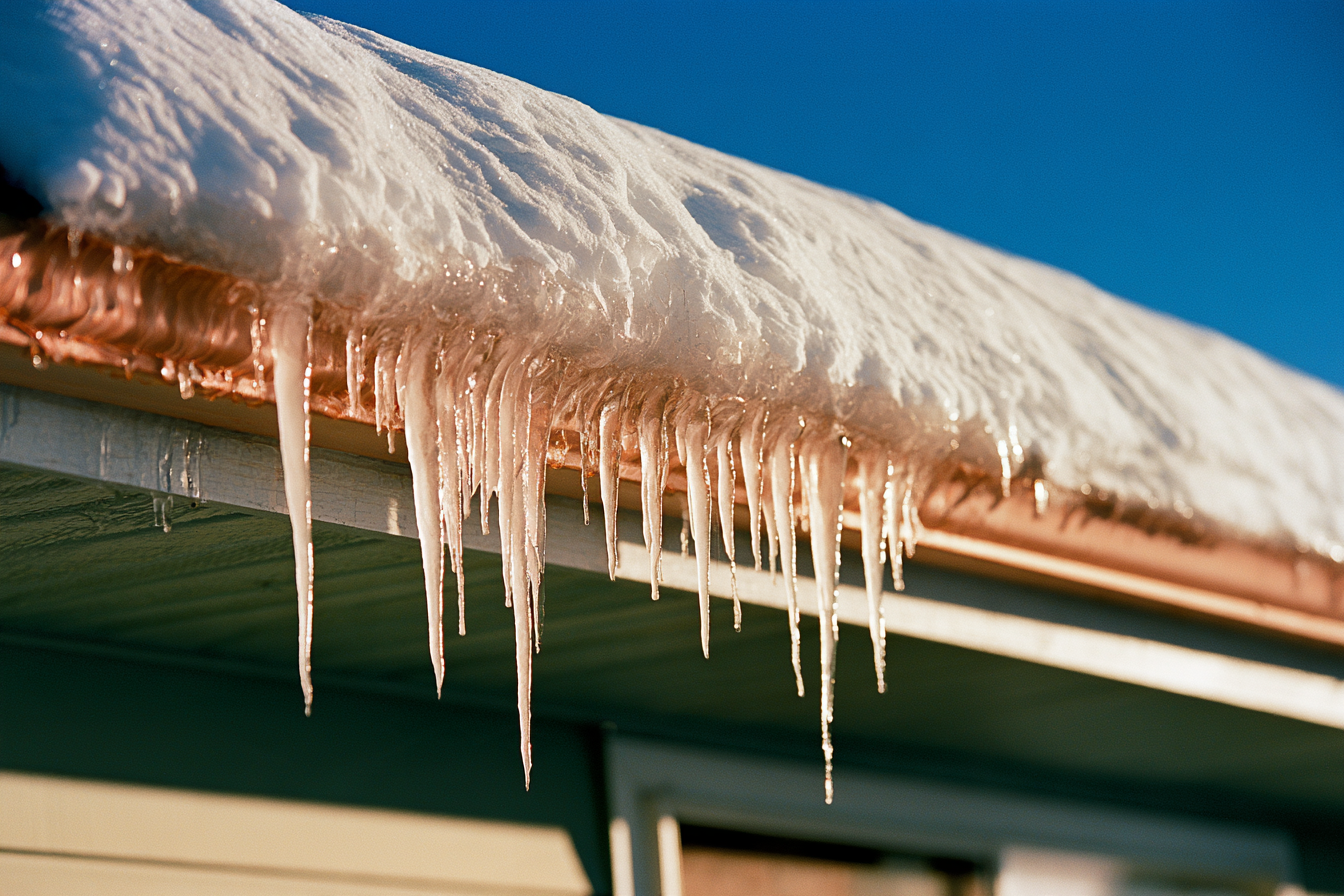
Icicles along the eave look harmless. What they usually mean is that your roof is melting snow unevenly, and the refrozen runoff is building a ridge of ice that traps water behind it. That trapped water works under the shingles, and once it is under the shingles it is in your insulation, your drywall, and your paint. This article explains why ice dams form, why Colorado's freeze-thaw pattern makes them a recurring problem here, and what actually prevents them, as opposed to what just treats the symptom.
How an ice dam actually forms
An ice dam needs two temperatures on one roof: warm enough near the ridge to melt snow, cold enough at the eave to refreeze it. Heat escaping from the living space warms the upper roof deck, snow melts from underneath, water runs down, and it refreezes when it crosses the unheated overhang. Repeat that cycle for a week and you get a ridge of solid ice at the eave with meltwater pooling behind it. Shingles shed water that runs downhill. They do nothing against water that is standing in a puddle above them.
Colorado is built for this cycle. Sunny 40-degree days after a storm, hard freezes every night, and high-altitude sun strong enough to melt the south face of a roof while the north eave stays frozen for weeks. Front Range homes can run this melt-refreeze loop a dozen times in a single winter.
The real cause is almost never the roof
Here is the part that surprises homeowners: ice dams are usually an insulation and air-sealing problem wearing a roofing costume. The heat melting that snow is escaping from your house, through can lights, attic hatches, duct runs, bathroom fan housings, and thin insulation. Fix the heat loss and the roof stays uniformly cold, the snow melts evenly with the weather, and the dam never forms.
The checklist, in order of impact:
Air sealing. Before adding any insulation, seal the leaks. Recessed lights, the attic hatch, plumbing and wiring penetrations, and duct joints are the usual offenders. Warm air moving through gaps carries far more heat than conduction through insulation ever will.
Attic insulation. Denver sits in climate zone 5, where current code calls for roughly R-49 to R-60 in the attic. A lot of older Front Range homes are sitting at R-19 or less. Blown-in insulation typically runs $1.50 to $3.50 per square foot installed, which makes it one of the cheapest fixes in this entire conversation, and it pays you back twice: no ice dams, lower heating bills.
Ventilation. Soffit and ridge vents keep the underside of the roof deck at outdoor temperature, flushing out whatever heat does escape. Ventilation is the backstop, not the primary fix. A ventilated attic over a leaky ceiling still grows ice dams.
What helps at the roof itself
When you are already replacing a roof, two details matter. First, ice and water shield, a self-adhering membrane applied at the eaves under the shingles. Colorado code requires it at the eave in most jurisdictions, but the difference between the code minimum and running it a full six feet up the deck is small money during a reroof and significant protection after. If a dam does form, the membrane is what keeps the trapped water out of the house. If your roof is approaching that decision anyway, our breakdown of roof replacement cost in Denver covers where details like this fit in the budget.
Second, gutters. Clogged gutters do not cause ice dams, but they give the first freeze a head start and hold meltwater against the fascia. If your gutters are overflowing, sagging, or dumping water at the foundation, that is its own project with its own payoff, and we cover it in our guide to gutter replacement in Denver.
Heat cable, the zigzag wire you see along eaves, is the symptom-management option. Installed it runs $400 to $1,200 for a typical eave run, and it works by melting drainage channels through the ice. It is a reasonable tool for a stubborn north-facing eave or a roof geometry that traps snow, like a low-slope section behind a dormer. It is not a substitute for fixing the heat loss. It is also an operating cost every winter it runs.
What not to do
Do not chip ice off the eave with a hatchet, a hammer, or anything else with an edge. Every spring we see shingle damage that cost more than the dam ever would have. Do not pressure-wash ice off a roof. And be careful with salt pucks: they work, but the runoff can stain siding and kill whatever is planted below the eave.
If water is actively coming in, a roof rake, a long-handled tool that pulls snow off the lower few feet of roof from the ground, is the safe immediate move. Removing the snow supply upstream of the dam stops the melt cycle until a permanent fix happens.
Reading the warning signs early
Icicles are the obvious tell, but the earlier signals are subtler: snow that melts in patches over one section of roof while the rest stays white, water stains at the top of exterior walls, or a ceiling stain that appears a few days after every storm, not during it. That delay is the signature of dam-driven leakage rather than a failed shingle. An annual look at the roof before the first storm, ideally by someone who knows what a compromised eave looks like, catches most of this. Our article on why roof maintenance is not always straightforward explains what a real inspection covers.
Snow sitting on the roof also carries weight, and a dam at the eave holds that snow in place longer than the weather would. For most homes this is fine. For older homes with marginal framing or additions built without engineering, it is worth understanding what your structure is rated to carry. Our guide to snow load requirements in Colorado covers when accumulation becomes a structural question.
The order of operations
If ice dams have been a recurring problem, the sequence that actually ends them looks like this: air-seal the attic floor, bring insulation to R-49 or better, confirm the ventilation path from soffit to ridge, and put proper membrane at the eaves the next time the roof is replaced. Heat cable covers whatever geometry problems remain. Most homes never need the cable once the first three are done.
The right contractor for this is one who talks about your attic before your shingles. If someone quotes you a fix that never mentions insulation or air sealing, you are buying the symptom treatment, and you will be buying it again next winter. Our roofing team approaches ice damming as a whole-house heat problem first, because that is what it is.