
Laundry Room Remodel Cost
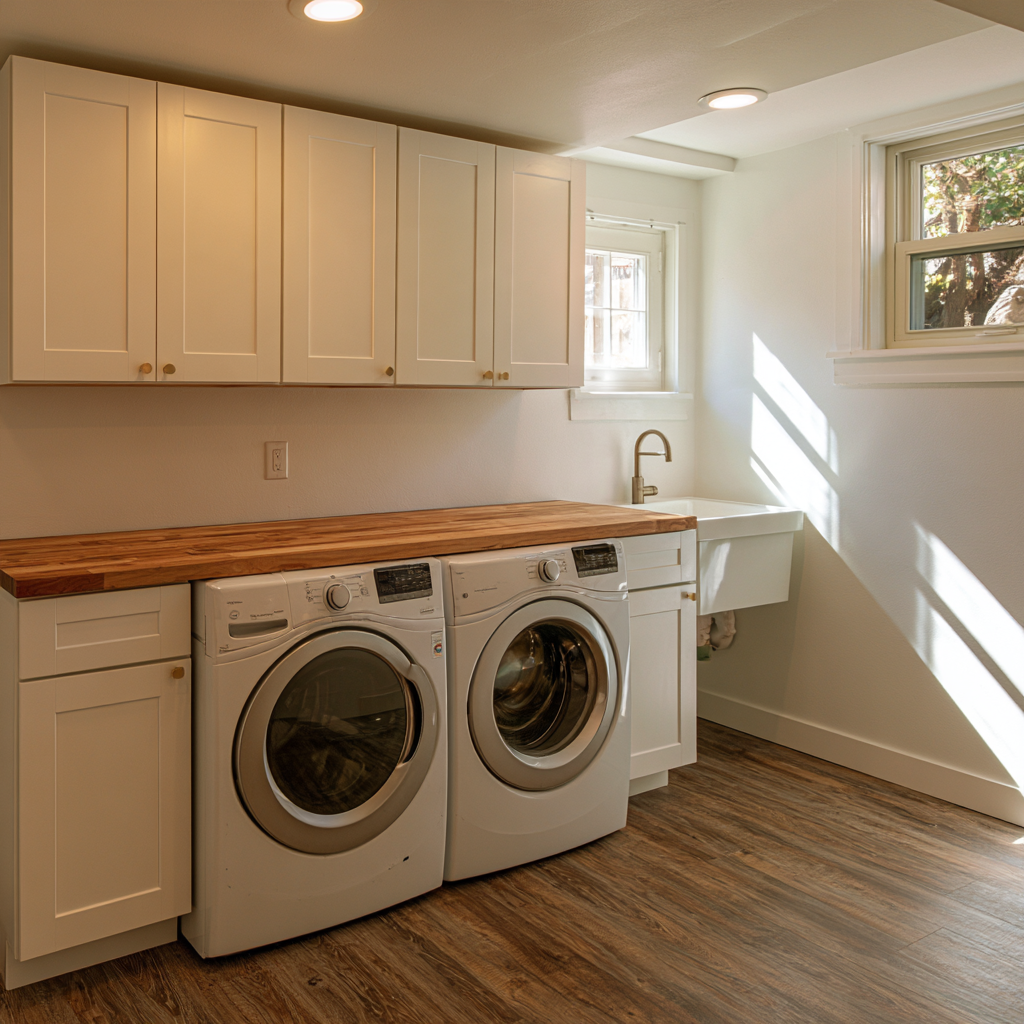
Most homeowners plan a laundry room remodel around what they will see: cabinets, a folding counter, better lighting, a floor that does not look like a garage. Those things matter, but they rarely decide the budget. What decides it is whether the water lines, drain, dryer vent, and power stay where they are or have to move. In Denver, where a lot of laundry still lives in unfinished basements built decades ago, that one question can swing a project by several thousand dollars.
This guide breaks down what a laundry room remodel actually costs, which line items move the number, and how to decide whether relocating the laundry is worth it.
What a laundry room remodel costs
National cost guides put the typical laundry room remodel between $6,000 and $17,000, with an average around $11,000. Denver projects tend to land in the middle to upper part of that range, mostly because of local labor rates and because so many of our laundry rooms start in rough condition.
It helps to think about it in three tiers.
A refresh in place, roughly $3,000 to $8,000. The washer and dryer stay where they are. The work is paint, new flooring, a run of stock or semi-custom upper cabinets, a counter over front-load machines, and better lighting. No walls move and the plumbing is untouched beyond reconnecting the appliances.
A full remodel in the same location, roughly $10,000 to $25,000. This is the most common scope. It usually adds base and upper cabinets, a utility sink, a new supply box and drain, an updated electrical circuit, a properly rerouted dryer vent, tile or LVP flooring, and sometimes a small layout change like stacking the machines to free up wall space.
A relocation or a new laundry room, roughly $20,000 to $40,000 or more. Moving laundry from the basement to the main or upper floor means new supply lines, a new drain and vent stack connection, a dedicated circuit or gas line, a new exterior vent penetration, and the finish work on top of it. If the new space has to be carved out of a closet or a bathroom, framing and patching add to that.
Appliances are separate from all of these numbers. A standard washer and dryer pair runs roughly $600 to $1,000, and a high-end pair can pass $5,000.
Where the money actually goes
Cabinets are usually the largest visible cost. Installed cabinetry commonly runs $100 to $300 per linear foot depending on construction and finish, and a typical laundry room uses 8 to 14 linear feet once uppers and a base run are included. Counters over front-load machines are a smaller line item because the run is short, but stone gets expensive fast compared with butcher block or laminate.
The less visible costs are the ones that surprise people. A new drain line alone can run from a few hundred dollars to nearly $2,000 depending on distance and access. A dedicated 240-volt dryer circuit, or a gas line if the dryer is gas, adds electrician or plumber time. A dryer vent that has to be rerouted to meet code can mean opening a ceiling or an exterior wall. Permits for the plumbing and electrical work typically add a few hundred to over a thousand dollars.
We cover the general pattern in more detail in our breakdown of how plumbing and electrical work affect the price of a remodel. Laundry rooms are a small, concentrated version of that same story.
Local factors that change the budget
A few things show up here more often than in a generic cost guide.
Basement laundry in older homes. Many Denver bungalows and Tudors have the laundry next to the furnace on a bare concrete floor, sometimes draining into a floor drain or laundry tub that predates current code. Bringing that space up to a finished standard often means a new standpipe and trap, a proper floor finish, better lighting, and dealing with any moisture before anything goes on the walls. If the laundry is part of a larger basement project, it makes sense to plan it with the rest of the finish work rather than as a separate job. Our guide to basement finishing costs shows how those budgets fit together.
Dryer vent length and routing. Building code limits how long a dryer exhaust duct can run, with the allowed length reduced for every elbow. Basement laundry rooms in the middle of a house often fail that test once they are remodeled, which is when venting turns into a real line item. A vent that is too long is not just a code issue. It is a lint and fire risk and it makes the dryer run longer every load.
Freezing on exterior walls. Laundry hookups on an exterior wall or in an attached garage are exposed to Colorado cold snaps. Supply lines in those walls need to be insulated properly or relocated, or the first hard freeze becomes a water damage claim.
Permits. Denver requires permits for most plumbing, gas, and electrical changes. A cosmetic refresh usually does not need one. Moving hookups, adding a circuit, or running a new gas line does. Our overview of Denver remodel permits explains what triggers a permit and how long review typically takes.
Should you move the laundry upstairs?
This is the decision that matters most, and it is worth thinking through before anyone prices cabinets.
Moving laundry closer to the bedrooms makes daily life easier, and it is one of the more common requests we get in two-story homes and second-story additions. The tradeoff is cost and risk. A relocation adds the plumbing, venting, and electrical work described above, and it puts thousands of gallons of water a year above finished ceilings. If you go that route, a drain pan under the washer, a leak sensor with an automatic shutoff valve, and properly secured supply lines are inexpensive insurance.
Floor structure matters too. A front-load washer on its spin cycle can shake an undersized floor, so we look at joist size and span before committing to a location.
Staying in the basement is often the better value when the basement is being finished anyway, when the household does laundry in large weekly batches, or when the budget is tight. Moving up is usually worth it when the basement trip is a daily burden, when an upstairs closet or bathroom can be converted without major framing, or when the house is already getting a larger remodel that opens the walls.
Common mistakes that cost money
The most common one is buying appliances before the space is designed. Machine depth, door swing, and whether the pair stacks change cabinet layout, counter height, and sometimes the hookup location. Pick the appliances first, or at least their dimensions.
The second is skipping storage planning. A laundry room with good built-ins does far more work than one with a single shelf over the machines. Our article on built-in storage that improves how a home works covers how to plan that without overbuilding.
The third is leaving the vent, the shutoff valves, and the drain as they are because they are hidden. If the walls are open, that is the cheapest time to fix them. Once cabinets are installed, it is not.
Finally, set realistic allowances for cabinets and finishes before the project starts. Loose allowances are where small projects quietly double. Our piece on allowances in a remodel budget explains how to set numbers you can actually hold.
What this means for your project
If your laundry stays where it is, a solid remodel is usually a five-figure project at the low end of that range, and a refresh can come in well under it. If it moves, plan for the plumbing, venting, power, and permit work to be a large share of the budget before any finishes are chosen.
Start with three questions: where the laundry should live, which machines you are using, and what condition the existing lines and vent are in. Those answers set roughly 80 percent of the cost. The finishes set the rest.
Denver Dream Builders plans laundry rooms as part of basement finishes, whole-floor remodels, and additions, which is usually where the plumbing and venting can be done most efficiently. If you are weighing a laundry update alongside a larger project, our general contracting team can walk the space and tell you which scope actually makes sense for the house.